Agenda Faculty Hotel Register Online
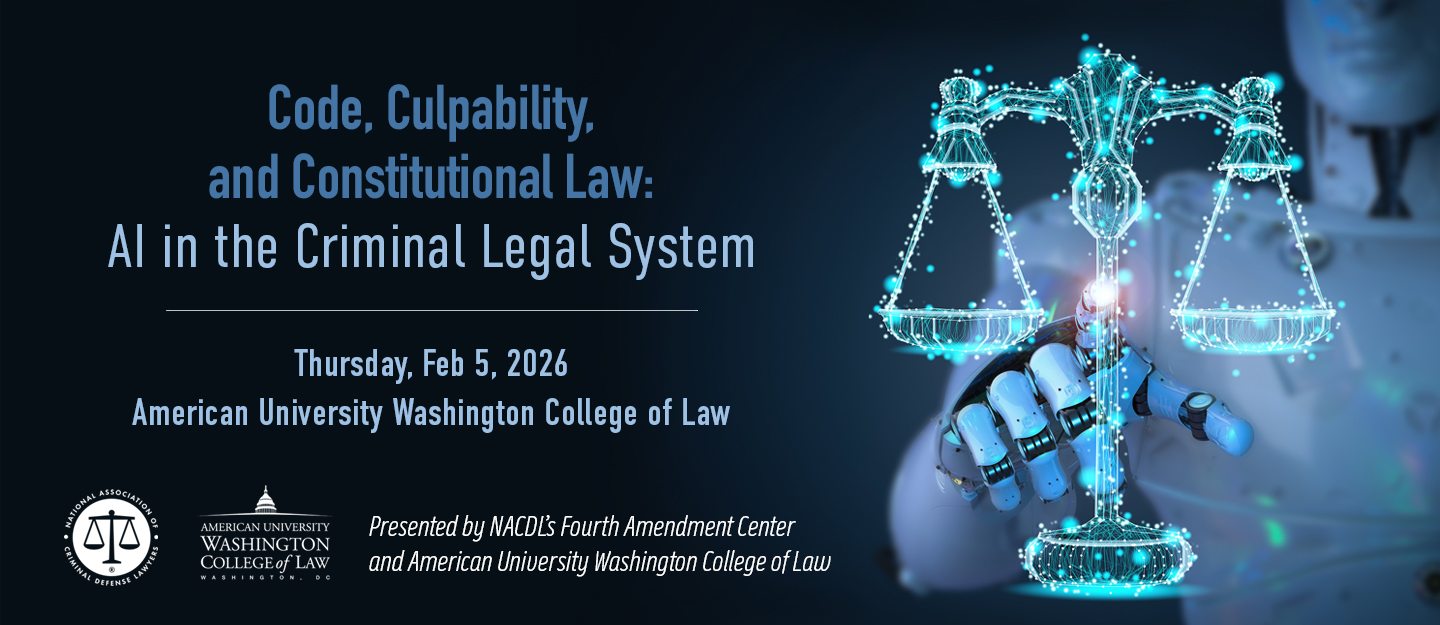
Artificial intelligence now influences nearly every stage of the criminal process—from data driven policing and digital forensics to sentencing algorithms. Yet the opacity of these tools raises urgent questions about fairness, accountability, and the right to a transparent defense. This symposium explores the ethical and evidentiary implications of AI in criminal law, focusing on algorithmic bias, trade secrets, police surveillance, and the tension between technological innovation and constitutional protections.
LOCATION: American University’s Washington College of Law, Washington, DC
DATE: Thursday, February 5, 2026
COST: FREE, Registration Required
CLE Credit: Not available
Seminar Venue:
American University’s Washington College of Law
4300 Nebraska Ave NW
Washington, DC 20016
Questions? Contact Julian Wallace jwallace@nacdl.org, 202-465-7652
Agenda
The program agenda and faculty are subject to change.
| Thursday, February 5, 2026 | |
|---|---|
| 7:30 am | Registration |
| 8:00 am | Refreshments |
| 8:30 am | Opening Remarks |
| 9:00 am | Algorithmic Power and Carceral Expansion: AI, Markets, and the Privatization of State Authority – Amba Kak Description: Explores how privately developed AI systems are reshaping how the state exercises power in the criminal legal system. This opening session will examine the political economy of AI, including vendor influence, procurement practices, proprietary algorithms, and the implications for democratic accountability, constitutional rights, and defense advocacy. |
| 9:30 am | Beyond “Neutral Tools”: Ethical Limits of AI in the Criminal Legal System – Amba Kak, Michael Ralph and Megan Graham Description: AI is often presented as objective and efficiency-enhancing, but its deployment occurs within a system marked by deep structural inequality. This panel interrogates ethical frameworks for deploying AI in criminal legal contexts, focusing on bias, opacity, automation bias, due process, and whether some uses of AI are fundamentally incompatible with justice. |
| 10:30 am | Toward Model AI Ethics Guidelines for Defense Lawyers - Katherine Tang Newberger Description: As AI increasingly shapes both defense practice and the evidence used against clients, defense lawyers face new ethical challenges. This session focuses on developing model ethics guidelines addressing competence, confidentiality, and client consent. |
| 10:45 am | Break |
| 11:00 am | Challenging Carceral AI: A Conversation with Timnit Gebru and Jumana Musa Description: Dr. Timnit Gebru and Jumana Musa confront the growing use of artificial intelligence as a tool of surveillance, punishment, and social control. The conversation will examine how AI technologies reproduce structural inequality in the criminal legal system while shielding powerful institutions from accountability. The speakers will address the limitations of AI, explore how AI entrenches racial and social hierarchies, and the ethical concerns of unleashing these tools in a system marked by a lack of due process, mass incarceration and racial injustice. |
| 12:00 pm | Lunch Break |
| 1:30 pm | What’s in the Black Box?: Litigation and Practice Challenges of AI in Criminal Cases - Maneka Sinha, Rebecca Wexler and Elizabeth Daniel Vasquez Description: This practice-oriented panel examines how AI appears in everyday criminal cases and the obstacles it creates for defense attorneys. Topics include discovery and disclosure, trade secret claims, admissibility, expert testimony, and strategies for cross-examining and contesting AI-generated or AI-assisted evidence. |
| 2:30 pm | When Machines Certify Death: AI, Forensic Pathology, and Evidentiary Reliability - Dr. Jay Stahl Herz Description: AI is increasingly incorporated into forensic pathology despite a lack of regulations on its use. This session examines how AI may amplify existing forensic weaknesses, raising questions about notice, validation, bias, error rates, and admissibility. |
| 2:50 pm | Break |
| 3:15 pm | Digital Cages: ICE, Surveillance, and the Machinery of Crimmigration - Paromita Shah Description: Technology fuels the expansion of crimmigration—the entanglement of immigration enforcement with the criminal legal system. This session will examine how databases, biometrics, predictive tools, and private tech contractors enable racialized policing, detention, and deportation at scale. |
| 3:30 pm | Watching Kids: AI, Youth Surveillance, and Criminalization - Shreya Tewari, Nila Bala, Lia Epperson, Clarence Okoh Description: Young people are increasingly subject to AI-driven surveillance through schools, social media monitoring, and predictive systems. This panel explores how these technologies affect privacy, autonomy, and pathways into the criminal legal system, with particular attention to racialized impacts and long-term consequences for youth. |
| 4:30 pm | Closing Remarks |
Faculty
Nila Bala
Nila Bala is an Acting Professor of Law at UC Davis School of Law. She researches and writes in the fields of children’s rights, criminal law, evidence, and emerging technologies. In 2024, she was selected as a UC Davis Public Scholarship Faculty Fellow for her public outreach work. In 2025, her paper, Policing Children’s Data, was awarded the Ian Kerr Best Paper Prize by the Privacy Law Scholars Conference. Her recent scholarship has appeared or is forthcoming in the Michigan Law Review, Washington University Law Review, Boston College Law Review, University of Chicago Law Review Online, Federal Sentencing Reporter, and the New York University Review for Law & Social Change, among other journals. Her essays for broader audiences have appeared in the New York Times, The Washington Post, Los Angeles Times, USA Today, Slate, Newsweek, and elsewhere. Before entering law teaching, she was at the Policing Project at New York University School of Law and R Street Institute. Bala also previously served as a public defender in Baltimore, Maryland and Santa Clara County, California. She is also a former preschool teacher. Bala received her bachelor’s degree in human biology from Stanford University, graduating with distinction. She completed her J.D. at Yale Law School.
Lia Epperson
Lia Epperson is a Professor of Law at American University Washington College of Law and a nationally recognized expert in the areas of constitutional law, civil rights, and education policy. Published in leading journals, Professor Epperson’s scholarship centers on the constitutional dialogue between federal courts and the political branches, and its implications for educational equity. She previously served as Senior Associate Dean for Faculty and Academic Affairs and as the Director of the Doctor of Juridical Studies Program. Professor Epperson received the American University Excellence in Teaching Award in 2022. Last year, she served as the Inaugural Microsoft Technology and Racial Equity Fellow at Howard University School of Law. In 2018-2019, Professor Epperson was awarded an Institute for Advanced Studies Fellowship with the Collegium de Lyon in Lyon, France where she worked with international scholars on issues of constitutional law and fundamental rights. Among other international engagements, she has served as a visiting professor and lecturer at the University of Navarra, Central European University, and the University of Galway. Professor Epperson has appeared on news outlets including the BBC, CNN, NBC News, CBS, NPR, and C-SPAN. Professor Epperson previously served on the faculties of University of Maryland and Santa Clara University, and as a Senior Fellow at the Center for American Progress where she focused on civil rights enforcement of educational policies and practices. Prior to becoming a law professor, she directed the education law and policy group of the NAACP Legal Defense Fund (LDF). While there, she litigated in federal and state courts, advocated for federal administrative and legislative reforms, co-authored multiple amicus briefs to the U.S. Supreme Court, and represented LDF in several national civil rights leadership coalitions. Professor Epperson began her legal career as a law clerk on the U.S. Court of Appeals for the Third Circuit and was an attorney with a large international law firm where she handled trial and appellate litigation as well as pro bono civil rights cases. Professor Epperson currently serves on the National Board of Directors of the American Civil Liberties Union and the Project on Government Oversight. Professor Epperson received her law degree from Stanford University where she was an NAACP Legal Defense Fund Scholar and an editor of the Stanford Law Review and the Stanford Law and Policy Review. She received her bachelor's degree, magna cum laude, from Harvard University.
Timnit Gebru
Dr. Timnit Gebru is DAIR’s founder and executive director. Prior to that she was fired by Google in December 2020 for raising issues of discrimination in the workplace, where she was serving as co-lead of the Ethical AI research team. Timnit also co-founded Black in AI, a nonprofit that works to increase the presence, inclusion, visibility and health of Black people in the field of AI, and is on the board of AddisCoder, a nonprofit dedicated to teaching algorithms and computer programming to Ethiopian and Jamaican highschool students. She has received a number of accolades including being named one of Nature’s Ten people who helped shape science and one of TIME 100’s most influential people. She is currently writing The View from Somewhere, a memoir + manifesto arguing for a technological future that serves our communities instead of one that is used for surveillance, warfare, and the centralization of power by Silicon Valley.
Megan Graham
Megan Graham is an Associate Clinical Professor and the Director of the Technology Law Clinic at the University of Iowa College of Law. Her work centers on the role technology plays in criminal cases and the broader criminal legal system. Professor Graham regularly advises direct legal services attorneys on the technology issues that appear in their clients’ cases, including overbroad search warrants for digital devices, probabilistic genotyping software, and facial recognition, among others. She has filed and litigated public records act requests to uncover more information about technologies used in criminal investigations and cases.
Dr. Jay Stahl Herz
Jay Stahl-Herz, MD is a board certified forensic pathologist with over thirteen years experience in full-time practice. He attended medical school at New York Medical College. He completed a four year residency in Anatomic and Clinical Pathology at NYU Langone Medical Center. He completed fellowships in Forensic Pathology and Neuropathology and Cardiac Pathology at the New York City Office of Chief Medical Examiner. He has previously held clinical academic appointments at NYU School of Medicine and SUNY Downstate School of Medicine. He has practiced forensic pathology in 10 states and has testified as a qualified expert in forensic pathology over 100 times. He is a Fellow of the National Association of Medical Examiners (NAME) where he serves on several high-level committees and is a NAME Certified Accreditation inspector. Since 2022, he has focused on providing forensic pathology services and consulting through his company Brooklyn Forensics LLC.
Amba Kak
Amba Kak has spent the last fifteen years designing and advocating for technology policy in the public interest, ranging from network neutrality to privacy to algorithmic accountability, across government, industry, and civil society – and in many parts of the world. Amba brings this experience to her current role co-leading AI Now, a US-based research institute where she leads on advancing diagnosis and actionable policy recommendations to tackle concerns with artificial intelligence and concentrated power. Amba recently completed her term as Senior Advisor on AI at the Federal Trade Commission. Prior to AI Now, she was Global Policy Advisor at Mozilla; and also previously served as legal advisor to India’s telecommunications regulator (TRAI) on net-neutrality rules. She regularly advises members of Congress, the White House, the European Commission, UK government, the City of New York, US and other regulatory agencies worldwide; and has testified before Congress multiple times on AI policy issues. Amba currently serves on the Board of Directors of the Signal Foundation and is a member of New York City’s Mayor Elect Zohran Mamdani's transition team. Trained as a lawyer, Amba received her BA LLB (Hons) from the National University of Juridical Sciences in India, and is a former recipient of the Google Policy Fellowship and Mozilla Policy Fellowship. She has a Masters in Law (BCL) and an MSc in the Social Science of the Internet at the University of Oxford, which she attended as a Rhodes Scholar. In 2024 TIME magazine listed Kak among 100 most influential people in AI.
Jumana Musa
Jumana Musa is a human rights attorney and racial justice activist. She is currently the Director of the Fourth Amendment Center at the National Association of Criminal Defense Lawyers. As director, Ms. Musa oversees NACDL's initiative to build a new, more durable Fourth Amendment legal doctrine for the digital age. The Fourth Amendment Center educates the defense bar on privacy challenges in the digital age, provides a dynamic toolkit of resources to help lawyers identify opportunities to challenge government surveillance, and establishes a tactical litigation support network to assist in key cases. Ms. Musa previously served as NACDL's Sr. Privacy and National Security Counsel. Prior to joining NACDL, Ms. Musa served as a policy consultant for the Southern Border Communities Coalition, a coalition of over 60 groups across the southwest that address militarization and brutality by U.S. Customs and Border Protection agents in border communities. Previously, she served as Deputy Director for the Rights Working Group, a national coalition of civil rights, civil liberties, human rights, and immigrant rights advocates where she coordinated the “Face the Truth” campaign against racial profiling. She was also the Advocacy Director for Domestic Human Rights and International Justice at Amnesty International USA, where she addressed the domestic and international impact of U.S. counterterrorism efforts on human rights. She was one of the first human rights attorneys allowed to travel to the naval base at Guantanamo Bay, Cuba, and served as Amnesty International's legal observer at military commission proceedings on the base. Ms. Musa has also worked as a policy attorney for the National Network to End Domestic Violence and handled international relations and immigration issues as a fellow in the office of Congressman Jesse L. Jackson, Jr. As an adjunct professor at Georgetown University's Center for Contemporary Arab Studies, she taught the course "Human Rights in the Middle East and North Africa." In 2016, Ms. Musa received the Ralph Johns Civil Rights Award from the Arab-American Anti-Discrimination Committee in recognition of her work. Ms. Musa holds a BA in International Relations from Brown University and a JD from Georgetown University Law Center.
Katherine Tang Newberger
Katherine Tang Newberger is the First Assistant Federal Public Defender for the District of Maryland, where she has practiced since 2005. Based in Baltimore, Katherine represents individuals charged with death-eligible offenses, robbery, sexual exploitation of children, drug and gun crimes, fraud and regulatory violations. Although primarily a felony trial attorney, Katherine has represented juveniles as well as those charged with misdemeanors. She has litigated complex competency issues and has focused on the presentation of mitigation at sentencing. Katherine oversaw the District of Maryland’s response to the passage of the First Step Act, litigating Section 404 and compassionate release motions with unparalleled success: As of September 2021, Maryland had more grants of compassionate release than any other district in the country according to the U.S. Sentencing Commission. Katherine received a 2020 Leadership in Law Award from The Daily Record and the Maryland State Bar Association. Katherine is a former president of the Maryland Chapter of the Federal Bar Association, where she led efforts to diversify the Board and improve communication between the Board and the full membership of the Maryland Chapter. Katherine is a member of the Fourth Circuit Judicial Conference and the Maryland State Bar Association. Katherine graduated summa cum laude from Northwestern University, where she was the Valedictorian of the Medill School of Journalism. She graduated from Yale Law School and went on to clerk for the Hon. Matthew Kennelly of the U.S. District Court for the Northern District of Illinois and the Hon. Diana Gribbon Motz of the U.S. Court of Appeals for the Fourth Circuit.
Clarence Okoh
Clarence Okoh is a civil and human rights attorney working at the intersection of race, technology, and the law. He has led groundbreaking campaigns against AI rights abuses, including his role coordinating legal and organizing strategies with advocates in Florida to defeat one of the first-documented school-based policing programs in US history. He currently serves as Senior Attorney for Civil Rights & Technology at TechTonic Justice, a new national organization focused on the impact of AI and automation on low-income communities. He is a cofounder of the NOTICE Coalition: No Tech Criminalization in Education, a national network of advocates fighting against AI surveillance and algorithmic discrimination in schools. As an inaugural member of the Just Tech Fellowship hosted by the Social Science Research Council, he authored numerous publications, including Dangerous Data: What Communities Should Know About Artificial Intelligence, the School-to-Prison Pipeline, and School Surveillance. He has worked across a range of civil society organizations, including the NAACP Legal Defense Fund, the Center on Law and Social Policy (CLASP), and the Georgetown Law Center on Privacy and Technology. He is a graduate of the University of Chicago and New York University School of Law, where he was a Root-Tilden-Kern Scholar.
Michael Ralph
Dr. Ralph's research integrates political science, economics, history, and medical anthropology through an explicit focus on debt, slavery, insurance, forensics, and incarceration. He is currently at work on two books that center on slavery, insurance, and incarceration.
Paromita Shah
Paromita Shah, founding Executive Director of Just Futures Law, works alongside community-based movements to end mass deportation, criminalization, and surveillance. Answering a call from grassroots immigrants’ rights organizers, she co-founded Just Futures Law in 2019, a movement lawyering organization that provides cutting-edge legal support for grassroots organized advocacy campaigns, with a strong focus on surveillance and data technologies. She has authored dozens of resources and reports, is a 2023 Rockwood National LIO Yearlong Fellow and recipient of the 2020 Outstanding Clinical Alumni Award from Suffolk University Law School. She previously served as the Associate Director of the National Project of the National Lawyers Guild, the Detention Project Director at Capital Area Immigrants’ Rights Coalition in Washington DC, and was a staff attorney at Greater Boston Legal Services.
Maneka Sinha
Maneka Sinha has extensive experience in criminal litigation and is recognized for her expertise in forensic evidence and technology issues. Her scholarship explores the use of forensic evidence and policing technology in the criminal legal system. Professor Sinha's article, The Automated Fourth Amendment, received the Excellence in Scholarship award at the 2024 Workshop for AAPI/MENA Women in the Legal Academy. Her article, Challenging Automated Suspicion, was co-recipient of the Joel R. Reidenberg Award for Outstanding Scholarship by a Junior Scholar at the 2024 Privacy Law Scholars Conference. Professor Sinha was named a 2023-2024 AALS Bellow Scholar for her research exploring how policing technology reliability should be evaluated under the Fourth Amendment. In the fall 2025 semester, Professor Sinha is a Visiting Professor of Clinical Law at NYU Law, where she is teaching the school's first Forensic Defense Clinic. Prior to joining GW Law, Professor Sinha was a Professor of Law at the University of Maryland Francis King Carey School of Law, where she directed the Criminal Defense Clinic and taught courses on forensic evidence and technology. Before that, Professor Sinha spent ten years at the Public Defender Service for the District of Columbia, where she served as senior advisor to the agency’s director on forensic evidence issues and represented indigent clients charged with crimes in the District of Columbia. She also served as head of the agency’s nationally recognized Forensic Practice Group, training and supervising lawyers involved in forensic evidence litigation locally and nationwide, while personally litigating complex forensic evidence issues. In 2017, Professor Sinha was a fellow with the International Legal Foundation, supporting its work to establish a public defender agency in Nepal. In 2015, she served as a Brian Roberts Fellow in the West Bank, training and supervising Palestinian public defenders.
Shreya Tewari
Shreya Tewari serves as Resource Counsel for the Fourth Amendment Center at NACDL, which provides the defense bar with resources and litigation support designed to preserve privacy rights in the digital age. Shreya focuses on developing materials and resources on emerging Fourth Amendment issues to train and assist defense lawyers across the country and ensure they can best protect clients’ constitutional rights in the face of new surveillance tactics and technologies. Prior to joining NACDL, Shreya clerked for Hon. Adam Silvera in New York and was a Brennan Fellow at the ACLU’s Speech, Privacy, and Technology Project. As a Brennan Fellow, Shreya litigated a variety of First and Fourth Amendment issues including protest rights and aerial surveillance, government use of cellphone location data, and unavoidably shed DNA. Her work on a FOIA case revealing the extent of federal law enforcement’s access to cellphone location information was widely covered and referenced by various sources including Politico, The Verge, TechCrunch, Rolling Stone, the New Yorker, and the U.S. House of Representatives Judiciary Committee. Shreya holds a J.D. from the University of San Francisco where she was co-president of the Student Immigration Law Association. As a law student, Shreya worked at the ACLU of Northern California, the San Francisco Public Defender’s Office, CAIR-San Francisco Bay Area, and in USF’s Deportation Defense and Immigration Policy clinics.
Elizabeth Daniel Vasquez
Elizabeth has focused on the intersection of data, science, technology and the criminal legal system for more than a decade. She founded the Forensic Evidence Table in 2024. Elizabeth also owns her own consulting firm E. Daniel Vasquez Consulting. Before starting the Table, Elizabeth created and ran the Science and Surveillance Project and the Forensic Practice at Brooklyn Defender Services, worked as a staff attorney and member of the forensic practice group in the trial division of the Public Defender Service for the District of Columbia, and litigated wrongful conviction and civil rights cases involving forensic error and misconduct throughout the country with Neufeld Scheck & Brustin, LLP.
Rebecca Wexler
Rebecca Wexler’s teaching and research sit at the intersection of law and technology, with a specific focus on privacy and secrecy in the context of the criminal legal system. Her work has explored topics including trade secrets, data privacy, and law enforcement privilege. Wexler’s scholarship has appeared or is forthcoming in the Harvard Law Review, Stanford Law Review, The Yale Law Journal Forum, NYU Law Review, UCLA Law Review, Texas Law Review, Vanderbilt Law Review, and Berkeley Technology Law Journal, as well as in peer-reviewed computer science publications. She joined Columbia Law School on July 1, 2025. Wexler served as a senior policy advisor in the White House Office of Science and Technology Policy during spring of 2023, and she has testified before both the House and Senate Judiciary Committees. Her scholarly theories have been proposed for codification into federal law and litigated in multiple courts, including a cert petition to the U.S. Supreme Court. Her article “Privacy as Privilege” received the Privacy Law Scholars Conference Reidenberg-Kerr Award and was named a “Must Read” article by the National Association of Criminal Defense Lawyers. Her op-eds have appeared in the New York Times, Washington Post, and Los Angeles Times, among other outlets, and her work has been featured on NPR, among other media venues. Wexler clerked for Judge Pierre N. Leval on the U.S. Court of Appeals for the 2nd Circuit, and for Judge Katherine Polk Failla on the U.S. District Court for the Southern District of New York. Prior to joining the Columbia Law faculty, she was the Hoessel-Armstrong Professor of Law at the University of California, Berkeley School of Law, where she was also a faculty co-director of the Center for Law & Technology and the Center for Criminal Law & Justice.
Hotel
SEMINAR VENUE
American University’s Washington College of Law
4300 Nebraska Ave NW
Washington, DC 20016
HOTEL ACCOMODATIONS
Embassy Suites by Hilton at the Chevy Chase Pavilion
4300 Military Road NW
Washington, DC 20015
Online reservations: Reserve Your Room at the NACDL Room Block
Group rate: $139 + tax (expires January 28, 2026)
Rooms/discounted group rates are not guaranteed once the block has been filled.
Questions? Contact Julian Wallace jwallace@nacdl.org, 202-465-7652
Code of Conduct
NACDL endeavors to foster a working, learning, and social environment free of harassment, discrimination, intimidation, and insult. To that end, NACDL has adopted a Code of Conduct for Affiliated Persons that applies to all attendees and participants of any kind at all NACDL sponsored events.
Learn More