
November/December 2025
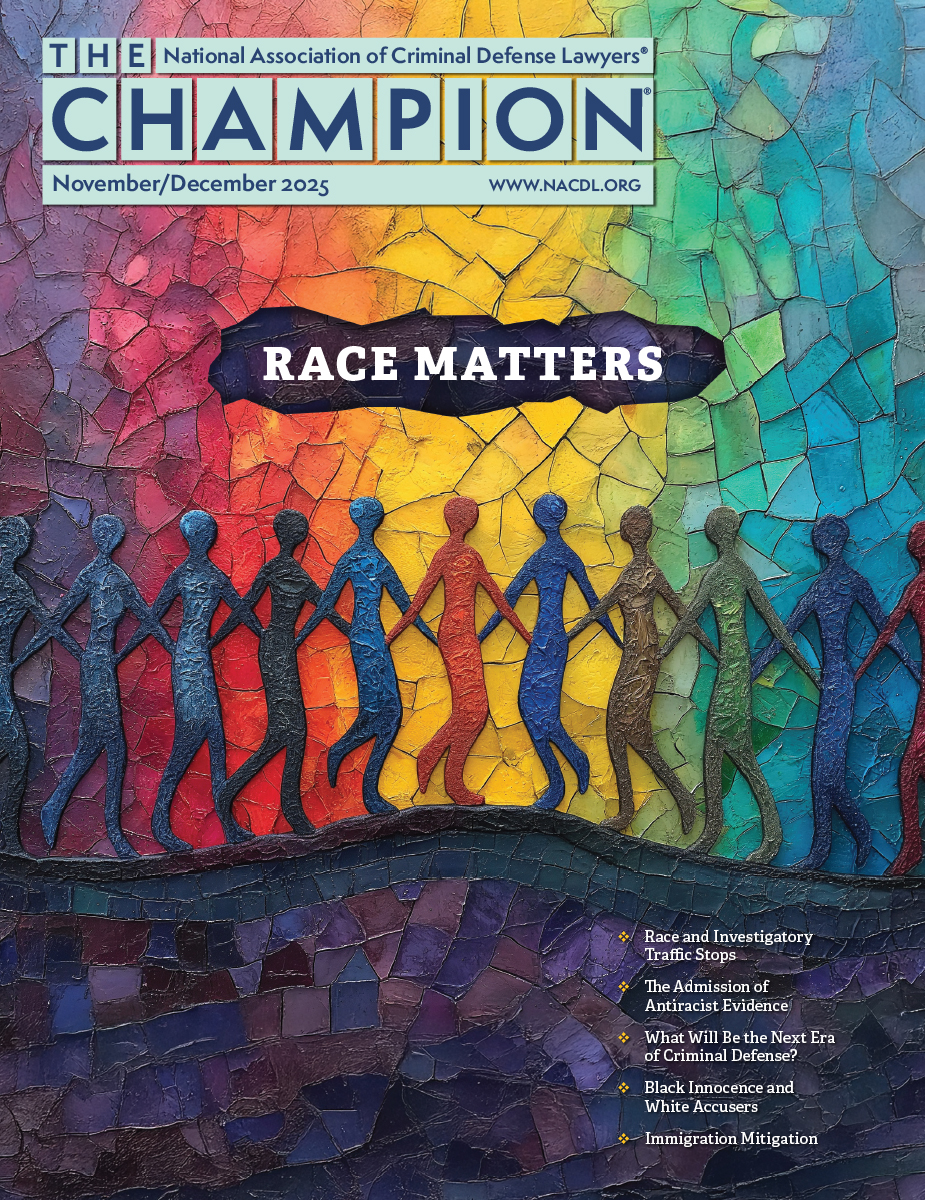
How can defense attorneys challenge pretextual traffic stops, i.e., traffic stops in which an officer uses a minor traffic infraction as a “pretext” to gain access to a vehicle to investigate a hunch?
Articles in this Issue
-
Affiliate News
What events are NACDL affiliates hosting this month? Find out here.
-
Black Innocence and White Accusers: Why Black Men Need Expert Testimony About False Accusations
by White Women to Get a Fair Trial
Priya Chaudhry and Awais Arshad write that when white women lie about being raped by Black men, they are believed and face no consequence for having lied. How can defense attorneys ensure a fair trial? The authors recommend offering expert testimony on Presumed Black Guilt (PBG). They say that this idea sits firmly on the well-accepted practice of allowing expert testimony that directly attacks the credibility of a witness.
-
Book Review: By the Fire We Carry by Rebecca Nagle
This month Jon Sands reviews By the Fire We Carry: The Generations-Long Fight for Justice on Native Land by Rebecca Nagle.
-
Defending Is Not Enough
Criminal defense has evolved over the decades, from client-centered lawyering and community-oriented defense to the advent of the holistic model. What will be the cornerstone of the next era of criminal defense?
-
From the President: Holding the Line: NACDL’s Charge in a Time of Democratic Crisis
Justice only survives if people are willing to protect it. The danger is escalating, as evidenced by calls for political “retribution” through criminal prosecution and the pardon power being used to reward loyalists. History will judge how we responded in this era.
-
Immigration: Immigration Mitigation Issues in Criminal Defense
To effectively advocate for immigrant clients, lawyers and criminal mitigation experts should uncover psychosocial information that pertains to defendants’ lives before coming to the United States and challenges encountered as first-generation immigrants.
-
In Memoriam: NACDL Remembers Past President Jerry Cox and Mark Rochon
Tribute to Jerry J. Cox and Mark J. Rochon
-
NACDL News: Abbe David Lowell Receives Champion of Justice Award from Nation’s Criminal Defense Bar
NACDL News for November/December 2025
-
NACDL News: Condemning EO Targeting Flag Burning, Citing Pernicious Pattern of Government Overreach
NACDL News for November/December 2025
-
NACDL News: Former U.S. Pardon Attorney Liz Oyer Receives NACDL Champion of Justice Award
NACDL News for November/December 2025
-
NACDL News: Kyle O’Dowd Recognized for 25 Years of Service to NACDL
NACDL News for November/December 2025
-
NACDL News: Nation’s Defense Bar Condemns Apparent Politicization of Justice in James Indictment
NACDL News for November/December 2025
-
NACDL News: Nation’s Defense Bar Slams ‘Trumped-up’ Indictment of Former FBI Director James Comey
NACDL News for November/December 2025
-
NACDL News: New Report Reveals How Federal Restitution Law Fails Both Defendants and Victims
NACDL News for November/December 2025
-
NACDL News: PDS Chief Addresses Board About Challenges and Developments Within Public Defense System
NACDL News for November/December 2025
-
NACDL News: Rachel Holmes Receives the 2025 Champion of State Criminal Justice Reform Award
NACDL News for November/December 2025
-
NACDL News: Report Calls Attention to Impact of Criminal Justice Act Payment Delays
on Defense Attorneys, Criminal Legal System
NACDL News for November/December 2025
-
Race and Pretextual Traffic Stops: Strategies for Challenging Whren v. United States & Its Vestiges
A pretextual traffic stop is one in which an officer uses a minor traffic infraction as a “pretext” to gain access to a vehicle and its passengers to investigate a hunch that the officer lacks the authority to investigate. Tia L. Holmes discusses state court challenges to these traffic stops that have been successful.
-
Reviews in Review
Reviews in Review for November/December 2025
-
Strengthening the Case for the Admission of Antiracist Evidence
Almost every criminal defense lawyer has had a case in which the lawyer feared that racism would trigger a wrongful conviction of the client. Professor Edward J. Imwinkelried discusses defense arguments for introducing expert evidence that will reduce the risk of racism triggering a wrongful conviction.