
July 2026
Some police reports are being written by artificial intelligence tools. What are the challenges and the opportunities for defense lawyers?
Articles in this Issue
-
Affiliate News
What events are NACDL affiliates hosting this month? Find out here.
-
Book Review: Lawless by Leah Litman
This month John Wesley Hall reviews Lawless: How the Supreme Court Runs on Conservative Grievance, Fringe Theories, and Bad Vibes by Leah Litman.
-
Book Review: Pardon Me by Craig Villanti
This month Denis deVlaming reviews Pardon Me: Mr. President: I Am Innocent of All Charges! by Craig Villanti.
-
Book Review: The Deserving by Elizabeth Vartkessian
This month Erin Pinder reviews The Deserving: What the Lives of the Condemned Reveal About American Justice by Elizabeth Vartkessian.
-
Book Review: Twice Burned by John Lentini
This month Maurice Possley reviews Twice Burned: A Fire Scientist’s Adventures in Overturning and Preventing Wrongful Arson Convictions by John Lentini.
-
Challenging Latent Fingerprint Identifications
Jurors come to trial believing that (1) fingerprint evidence must be accurate because fingerprints are widely used to identify people, and (2) fingerprint evidence must be accurate because every fingerprint is unique. How can defense counsel shake jurors’ confidence?
-
Filling the Gap — Using a Lawyer-Expert in Competence Assessments and Litigation
When addressing issues related to competence to stand trial, defense attorneys should consider the benefit of including a lawyer as a consultant or as an expert. Employing an experienced criminal defense lawyer to serve as a surrogate to explain the standards of practice and demands of the client’s case can insulate privileged information while helping the defense to present useful information about competence.
-
From the President: The Erosion We Cannot Ignore: Criminal Defense in an Era of Unchecked Power
Nothing could be more fundamental than the proposition that constitutional protections do not disappear because the government invokes immigration authority.
-
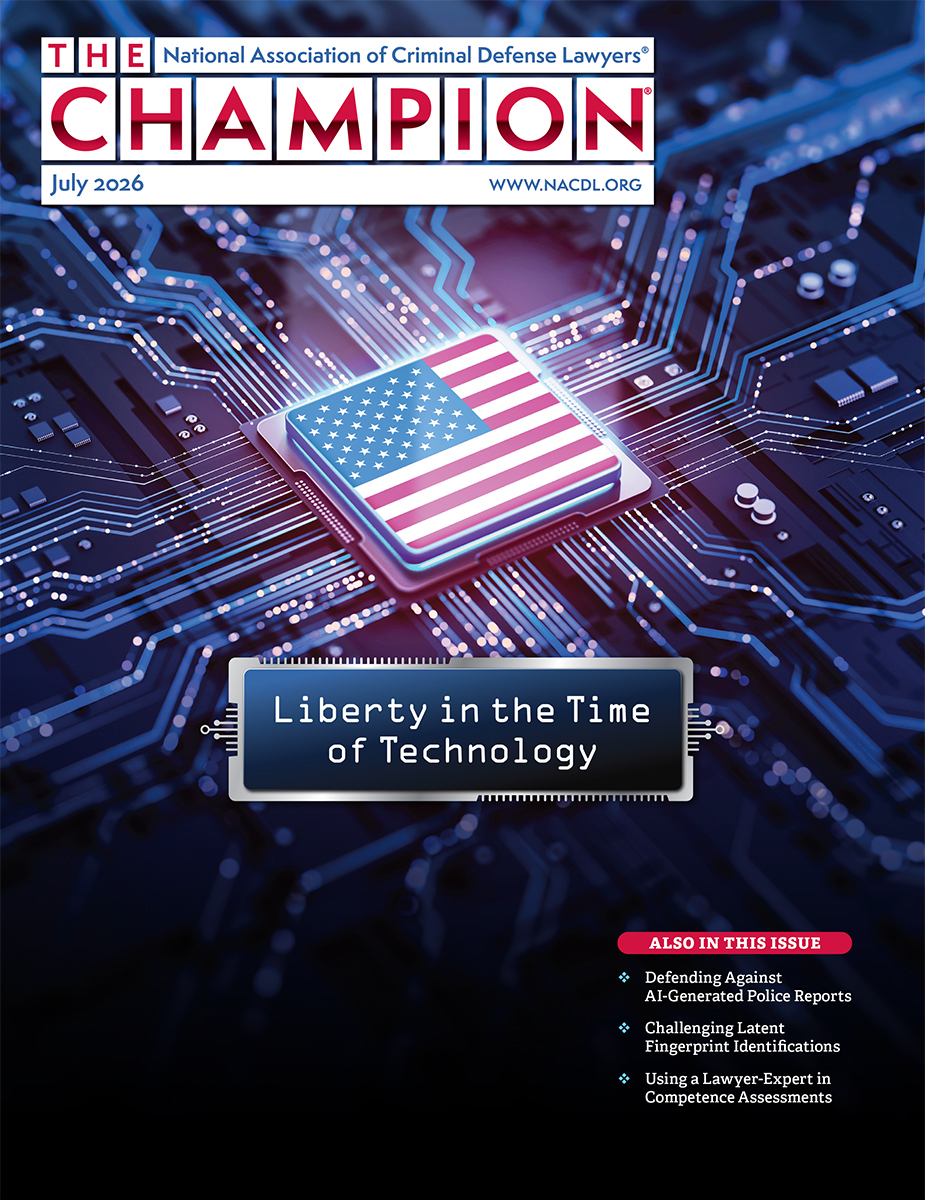
Liberty in the Time of Technology
The Founders did not anticipate cellphones, cloud storage, or AI surveillance. The challenge today is whether the Fourth Amendment can adapt as quickly as technology advances. As the United States celebrates 250 years of independence, it is a moment to reflect on the reasons for revolution and the promises of the Fourth Amendment in this digital age.
-
Memory & Perception: What Shapes Event Memory Besides the Event Itself?
Although many aspects of eyewitness memory for “what happened” can be accurate, eyewitnesses’ accounts of an event often contain predictable errors.
-
NACDL News: Monica Milton Receives Employee of the Year Honors
NACDL News for July 2026
-
Pozner on Cross: When Everyone Knows
The consistent use of leading questions conveys mutual knowledge and may result in the opponent’s witness being more honest, even when a denial might not be impeachable.
-
Reviews in Review
Reviews in Review for July 2026
-
The Ghost in the Machine: Defending Against the Rise of AI-Generated Police Reports
In the past, inconsistencies and errors in police reports provided excellent opportunities for cross-examination and deeper investigation. Things are changing. Some jurisdictions are turning to artificial intelligence tools to write police reports. What are the challenges for defense attorneys?