
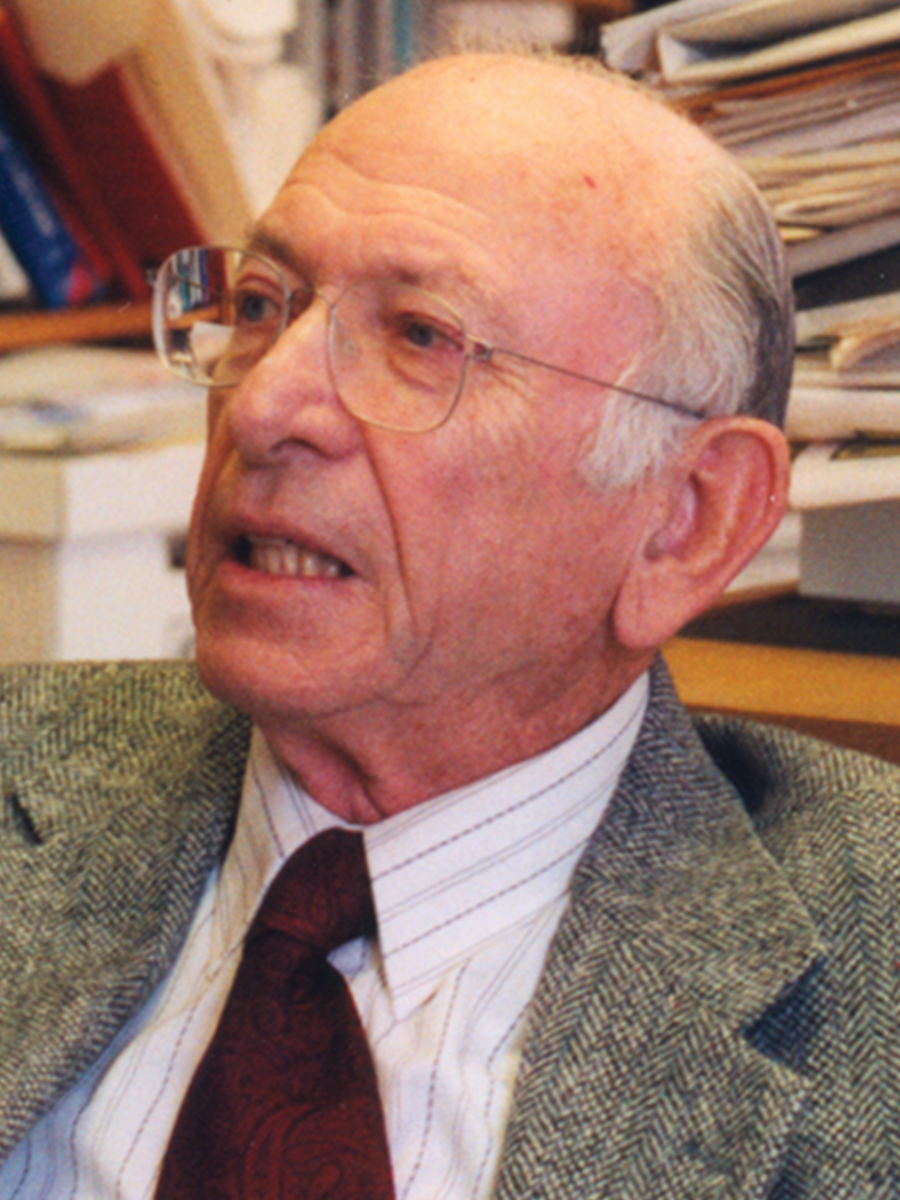
Liberty's Greatest Champion: Samuel Dash, Elliot Gold
Samuel Dash, a co-founder of NACDL, and its second President, died May 29 at the age of 79. Best known to the general public as the hard-nosed counsel to the Select Committee on Watergate, he and Senator Sam Erwin became synonymous with courage and integrity as they forced President Richard Nixon from office.
In the 1950s, Professor Dash saw the need for an organization of lawyers who defend the constitutional rights of those accused of crime. He specifically disliked the term “criminal lawyer,” and helped establish the National Association of Lawyers in Criminal Cases, which eventually became the National Association of Criminal Defense Lawyers. In Chicago in August 1958, Charles Bellows became the Association’s first President with Samuel Dash as Vice President. Edward Bennett Williams was one of the founding Board Members.
Compiled and edited by summer intern Elliott Gold, below are six tributes to Professor Dash from people who knew and loved him best.
Robert F. Drinan, S.J. Professor, Georgetown University Law Center at the memorial ceremony for Samuel Dash, June 1, 2004.
We gather together to express our admiration and our appreciation for the labors and the life of Samuel Dash.
At a critical moment in the history of our country Samuel Dash used his love of justice and his exceptional legal skills to expose secrecy and corruption at the highest levels of government.
The nation will ever be in his debt. He has made all of us proud to be the benefactors of a Constitution which has preserved the rule of law and the rights of all citizens to an open and transparent government.


We express our admiration and our compassion to Sam’s devoted wife Sara and his two daughters Judi and Rachel.
They are valiant women who have loved him and have shared in his victories for human rights in South Africa, Northern Ireland and elsewhere.
Samuel Dash rose at a critical moment in the history of the republic and brought fairness and civility to a scene where deception and corruption were rampant.
Sam, you have been our teacher, our mentor, our inspiration and yes our friend.
May the God of Abraham, Isaac and Jacob welcome you to paradise. And may your name be held in benediction forever and ever Amen.



Yale Kamisar, University of San Diego, Professor of Law Emeritus, University of Michigan
The first time I heard of Samuel Dash was 1959, the year he and two co-authors published The Eavesdroppers, a remarkable book that spelled out the phenomenal technological developments in electronic surveillance devices and the alarming degree to which police officers and “private eyes” alike were “bugging” and “tapping.” The Minnesota Law Review considered the book important enough to build a symposium around it (one to which I was happy to contribute).
The last time I saw Samuel was March 2003 at a Georgetown Law School symposium marking the 40th anniversary of Gideon. The passage of many years had not diminished his sense of injustice. He lashed out at the Bush administration for saying, in effect, that “lawyers can’t be trusted” to consult with suspected terrorists who hadn’t been found guilty of anything.
Until the very end, Samuel continued to teach, to speak out, and to write. Indeed, when he died Samuel had a book on search and seizure in press — the way, I think, he wanted it to end.
Steven H. Goldblatt, Professor of Law, Georgetown University Law Center
Samuel Dash distinguished himself professionally in so many different fields, both as a law professor and as a practicing lawyer, that few people even are aware of all the remarkable things that he did during his career. Fewer still had the opportunity that I had to work closely with him as a colleague for the past 20 years and to experience both his passion for justice and for advocacy of the highest quality. This passion was apparent regardless of whether he was prosecuting, defending, investigating, advising, acting as an expert witness, teaching or writing.
His death is a tremendous loss. He will live on however both in his accomplishments and in the hearts and minds of those who knew him well or were fortunate enough to be among the thousands of Georgetown law students who had him instruct them over the years in Criminal Procedure, Criminal Law, and Professional Responsibility. Samuel was a superb teacher and a little of his passion for the law and justice burns in each of them.
Samuel will be missed particularly by his family. Although he accomplished so much as a lawyer and law professor, he was a devoted husband and father who always believed that family, not career, came first.
Prof. Sherman L. Cohn, Georgetown University Law Center
If I were summarizing the essence of Samuel Dash who was my colleague for 39 years it would be with the sentence: “He really cared.” He was a teacher from whom we could all learned because he really cared about his students. In deed, he often said he loved his students. As they loved him. He also really cared about the law, about the Constitution, about the rights furnished by the Constitution. He worked hard to preserve those rights, often sticking his nose out to fight what he believed were significant inroads into those rights. As criminal procedure and professional ethics were his expertise, he worked hard to protect the rights furnished by the Fourth, Fifth and Sixth Amendments. Thus, he spoke up with strong words about the efforts of Attorneys General Richard Thornburg and Janet Reno to invade the protections that he felt were grounded in the Constitution. I had the great honor of working with Samuel on Watergate. There I saw his courage as well as his ability , fighting for the system of law and the rule of law that he knew underlay the genius of the American system. Above all, Samuel was the teacher: at all times, at all places. And he loved his students. He really cared.
Marvin Comisky, criminal defense lawyer, Philadelphia, PA
Samuel Dash was an individual with humility, integrity, courage, wisdom, an elevated sense of honor and fairness. All these characteristics merged into a highly-skilled professional lawyer with an innate regard for ethical behavior.
I knew him as a young District Attorney in Philadelphia, and thereafter, he started on his mercurial effort on behalf of the Rockefeller Institute leading to his elevated status at Georgetown Law School and the “Hill” and, indeed, for the Nation.
During a brief period, I was a member with Samuel of the then newly created Pennsylvania Committee for Revision of the Rules of Criminal Procedure. With one other defense attorney, we formed a threesome delegated to effect rules which contained an atmosphere of local respect for the rights and defense of those accused of crime. Our work was exciting because the prosecutors’ viewpoint was well represented by a majority of the Committee comprised of prosecutors, local and state, and judicial incumbents.
The work not only entailed long meetings at various locations within Pennsylvania, but also provided periods for social relationships. We enjoyed that opportunity to become warm and welcome friends of Sara and Samuel Dash, my wife and me.
When my term on that Committee terminated, I had the occasion from time to time to meet Sara and Samuel at various bar association functions and always we renewed our regard and warmth.
I followed Sam’s career, thereafter, from a distance. Always, I felt a glow of personal pride — as if by osmosis — for Sam’s accomplishments. He left a legacy in the law.
My personal admiration closes with respect for his loyal, lifetime-partner, Sara, who shared his accomplishments with her enduring love and intelligence.
Jerome J. Shestack, criminal defense lawyer, Philadelphia, PA
It is easy to write of Samuel Dash’s passion for justice, his fairness as a prosecutor, his insightful scholarship, and his devotion to our professional values. All of these qualities remain green in memory and warm in hearts. But I would like to add something I know would have pleased the Champion of Justice.
Samuel and I met at Harvard Law School. He was already married to Sara who kept, what I believe, the only Kosher kitchen in that remarkable Harvard class. Since I kept Kosher, Sara’s kitchen was a haven, I learned then, and all the years confirmed, that Sara was Sam’s partner in every sense of the term. Throughout their life together, she shared his dreams and ideals, contributed to their maturing and managed his affairs — books, appearances, engagements, career decisions — in a way that left him unburdened and free for scholarly pursuits and public service. Samuel gloried in that partnership, nourished by mutual love and enriched by common purpose.