Access to The Champion archive is one of many exclusive member benefits. It’s normally restricted to just NACDL members. However, this content, and others like it, is available to everyone in order to educate the public on why criminal justice reform is a necessity.
Over the past few years, several states have engaged in bad faith prosecutions of people who make good faith mistakes about their eligibility to vote. States force voters with felony convictions to navigate a complicated patchwork of felony disenfranchisement and rights restoration laws and, often, to sort through widespread mis- and disinformation. When people make good faith mistakes about their eligibility, some states prosecute them for voting or registering to vote while ineligible. In Florida, Gov. Ron DeSantis announced a large wave of voter prosecutions in 2022 despite evidence that most of the individuals targeted were confused or misinformed about their voting rights.{1}1 Sam Sachs, ‘Opening Salvo’: DeSantis Announces 20 Arrests for Voter Fraud in Florida, News Channel 8 (Aug. 19, 2022); 10 Reasons Courts Should Toss Florida’s Flimsy ‘Voter Fraud’ Prosecutions, Brennan Center for Justice (May 12, 2023). High profile prosecutions have also emerged from other states, including Texas{2}2 Neil Vigdor, O.P. Voter Fraud Crackdowns Falter as Charges Are Dropped in Florida and Texas, N.Y. Times, Oct. 21, 2022. and Tennessee.{3}3 Timothy Bella, She Was Told She Could Vote Again After Felony Convictions. Now She’s in Prison for Trying, Wash. Post, Feb. 4, 2022.
This article is an adaptation of an earlier article written by Blair Bowie. See Blair Bowie, Defending Against the Criminalization of Voting, The Champion, November/December 2023, at 14.
More recently, there has been a shift in this trend. Federal voter prosecutions are on the rise. Unlike state voter prosecutions, which have tended to target people with felony convictions, these federal prosecutions generally target noncitizens who have cast a ballot in a U.S. election, generally due to a mistake about their eligibility. These federal cases have arisen in places like Florida{4}4 See, e.g., United States v. Demydenko, No. 9:25cr80068 (S.D. Fla. May 8, 2025); United States v. Figueredo, No. 9:25cr80094 (S.D. Fla. May 10, 2025); United States v. Murray, No. 1: 26cr20104 (S.D. Fla. Apr. 25, 2026). — where large waves of state prosecutions have been seen — and in Pennsylvania{5}5 See, e.g., United States v. Custodio, No. 2:25cr385 (E.D. Pa. Sept. 3, 2025); United States v. Patel, No. 5:25cr452 (E.D. Pa. Oct. 14, 2025). and New York{6}6 See, e.g., United States v. McDonald, No. 1:25cr268 (N.D.N.Y. May 9, 2025); United States v. Jamiel, No. 1:25cr179 (N.D.N.Y. May 11, 2025). — where state prosecutions have been rare.
These prosecutions have severe consequences for targeted individuals, including jail time or even prison time, community supervision, immigration consequences, and other collateral consequences. The fallout does not end there. When individuals in a handful of highly publicized cases face harsh reprisals for good faith mistakes about their eligibility to vote, other voters are bound to take notice. Left unchecked, these prosecutions — combined with unreasonably complicated voting laws — could have a widespread chilling effect, deterring eligible voters with felony convictions, voters from immigrant communities or, potentially, even less-savvy voters who have no criminal record, from participating in our democracy for fear of the consequences of a mistake.
The best way to stem these consequences is to ensure that every person prosecuted receives a high-quality, robust, and attentive defense. That is why NACDL’s Criminalization of Voting Rights Committee is building a Rapid Response Team of attorneys who stand ready to respond to voter prosecutions as they arise. This article provides an overview of the criminalization of voting trend, addressing state and federal prosecutions, and introduces the new Rapid Response Team.
Defending Civic Freedoms
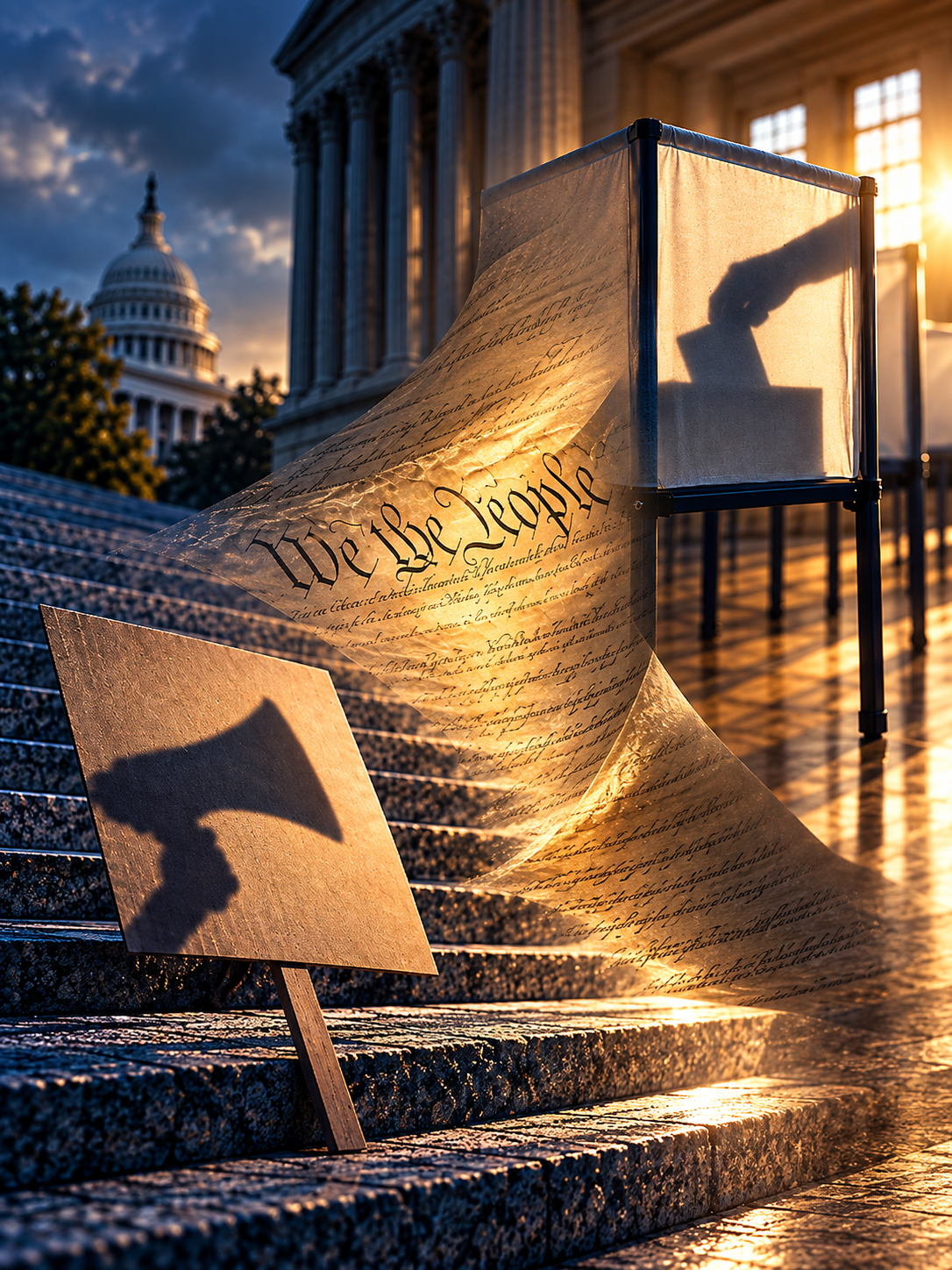
When civic participation is criminalized, defense lawyers stand between the individual and the power of the state. By defending people accused of crimes for voting, speaking out, or protesting, the defense bar protects not only an individual's liberty but the fundamental freedoms on which our democracy rests.
State Prosecutions
Felony disenfranchisement and rights restoration laws are complicated, ambiguous, and confusing.
To determine whether they are eligible to vote, system-impacted people in many states are forced to navigate a complicated web of laws governing felony disenfranchisement and voting rights restoration. These laws can vary significantly from state to state. Most states disenfranchise people convicted of any felony.{7}7 See, e.g., Md. Code Ann. Elec. L. § 3-102; Minn. Stat. § 201.014. Some states, however, disenfranchise for felonies and misdemeanors.{8}8 See, e.g., Mich. Elec. L. 168.758b; Ind. Code Ann. § 3-7-13-4; 730 Ill. Comp. Stat. Ann. § 5/5-5-5. Still, others disenfranchise people convicted of only a subset of felonies.{9}9 See Miss. Code Ann. § 23-15-19 (voter fraud and an enumerated list of crimes are disenfranchising); Ala. Code § 17- 3-30.1 (an enumerated list of felonies involving moral turpitude are disenfranchising); Alaska Stat. Ann. § 15.05.030 (crimes of moral turpitude are disenfranchising). In Tennessee, disenfranchisement depends on the date of conviction.{10}10 See Tenn. Code Ann. § 40-29-102. Two states and Washington, D.C., do not disenfranchise anyone for any conviction at all.{11}11 Me. Const. art. II, § 1; Me. Stat. tit. 21-A § 115; Vt. Const. ch. II, § 42; Vt. Stat. Ann. Tit. 17, § 2121; D.C. Code § 1-1001.02.
The restoration laws are just as complicated and varied as the disenfranchisement laws. Some states restore rights when the state releases a person from incarceration.{12}12 See, e.g., Cal. Const. art. II, § 4; Colo. Const. art. VII, § 10; Conn. Gen. Stat. Ann. § 9-46a; Haw. Rev. Stat. Ann. § 831-2; 730 Ill. Comp. Stat. Ann. 5/5-5-5; Ind. Code Ann. § 3-7-13-5. Other states require some combination of completion of probation and parole, payment of legal financial obligations, and even payment of child support.{13}13 See, e.g., Alaska Stat. Ann. 15.05.030; Idaho Code Ann. § 18-310; Kan. Stat. Ann. § 21-6613; La. Stat. Ann. § 18:102 (except that voting rights are restored to persons on probation or parole once five years have elapsed since actual incarceration); Mo. Ann. Stat. § 115.133; S.C. Code Ann. § 7-5- 120(B)(2)-(3); W. Va. Code Ann. § 3-2-2; Wis. Stat. Ann. § 6.03(1)(b); Tenn. Code Ann. § 40-29-102; Fla. Stat. Ann. § 98.0751. In some states, rights restoration is automatic.{14}14 See, e.g., Colo. Const. art. VII, § 10; Conn. Gen. Stat. Ann. § 9-46a; 730 Ill. Comp. Stat. Ann. 5/5-5-5; Ind. Code Ann. § 3-7-13-5. In others, people seeking to restore their rights must obtain a certificate, court order, legislative act, or pardon.{15}15 See, e.g., Ala. Code § 15-22-36.1; Ariz. Rev. Stat. § 13-906; Tenn. Code Ann. § 40-29-102. The rights restoration procedure can also vary depending on what crime a person was convicted of, what state a person was convicted in, or the number of crimes a person was convicted of.{16}16 See, e.g., Ala. Code § 17- 3-30.1; Tenn. Code Ann. § 40-29-102; Ariz. Rev. Stat. § 13-907. Some states fail to apply their own policies uniformly, meaning that restoration practices can vary from one locality to the next.
Moreover, these laws are often ambiguous. In Alabama, for example, the list of disqualifying crimes includes a series of crimes from the Alabama criminal code and “[a]ny crime as defined by the laws of the United States or by the laws of another state, territory, country, or other jurisdiction, which, if committed in this state, would constitute one of the offenses listed in this subsection.”{17}17 Ala. Code § 17-3-30.1(56). The state, however, has provided no guidance on how registrars should decide what out-of-jurisdiction crimes “would constitute” an in-state disenfranchising crime. This leaves some Alabama residents with non-Alabama convictions with no way to determine whether they are eligible to register and vote. Similarly, in Florida, the voting rights restoration laws changed at least six times between Jan. 1, 2019, and Election Day in 2020,{18}18 Amendment 4 and SB 7066 Implementation and Litigation Timeline, Brennan Center for Justice (Nov. 2022). causing widespread confusion about rights restoration.
In the face of this complicated landscape, states should take responsibility for ensuring their citizens are aware of laws governing voting. Instead, states often set these voters up to fail by not informing them about the status of their voting rights. In some states, even state officials cannot be relied upon for accurate information on voting eligibility. Individuals should not be asked to navigate laws that state election officials themselves struggle to interpret. Yet many states require voters who wish to exercise their fundamental right to vote to do just that.
Ineligible voting crimes require specific knowledge of ineligibility.
Hampered by complex laws and their inconsistent application, it is not surprising that individuals often make mistakes about their eligibility to vote. But voters should not be prosecuted for good faith mistakes. In states that are actively prosecuting people for ineligible voting, the relevant statutes contain explicit knowledge requirements.{19}19 See, e.g., Tex. Code Ann. § 64.012; Fla. Stat. Ann. § 104.15; Fla. Stat. Ann. § 104.011; Tenn. Code Ann. § 2-19-107. The knowledge mens rea applies not only to the act of registering but also to the fact that the registrant was ineligible. In other words, people must know that they are ineligible when they register or vote to be criminally liable. However, because it is so difficult to navigate the complicated voting laws governing disenfranchisement and reenfranchisement, the few people who vote while ineligible generally do so due to a mistake about their eligibility. These honest mistakes do not satisfy the mens rea required for criminal liability.
Still, people are being prosecuted and convicted for good faith mistakes. It is worth considering two factors at play in these convictions in greater detail. First, many courts struggle to apply the knowledge requirement correctly. For example, the Texas Election Code makes it a crime to “vote[] … in an election in which the person knows the person is not eligible to vote.”{20}20 Tex. Elec. Code § 64.012(a). Yet Crystal Mason was sentenced to five years in prison for casting a provisional ballot while on probation for a felony conviction, mistakenly believing she was eligible to vote.{21}21 Alexa Ura, Crystal Mason’s Contentious Illegal Voting Conviction Must Be Reconsidered, Criminal Appeals Court Says, Texas Tribune, May 11, 2022. Ms. Mason testified that she believed she was eligible to vote when she cast her ballot.{22}22 Id. But the trial court judge did not take her specific intent into consideration, and the intermediate court of appeals upheld her conviction, reasoning that the state only had to prove that Ms. Mason “voted while knowing the existence of the condition that made her ineligible — in this case, that she was on federal supervised release after imprisonment for a final felony conviction.”{23}23 Mason v. State, 598 S.W.3d 755, 770 (Tex. App. 2020). The Texas Court of Criminal Appeals reversed, holding that the language of the statute “requires knowledge that a defendant herself is ineligible to vote, not simple negligence,” and that the trial court “erred by failing to require proof that [Ms. Mason] had actual knowledge that it was a crime for her to vote while on supervised release.”{24}24 Mason v. State, 2022 WL 1499513 *1.
The second reason that convictions sometimes result from good faith mistakes is that defendants often face immense pressure to take plea agreements. In these cases, it is common for plea deals to involve no jail time. The consequences of a loss at trial, however, generally include multiple years of incarceration. Even people who are not guilty of the crime charged, therefore, will often choose to take the plea. This is particularly true when, as is common in ineligible voting cases, the charges tend to be rushed and inflated. In Tennessee, for example, Pamela Moses was charged with 14 counts of illegal voting.{25}25 Indictment, State of Tenn. v. Pamela Moses, No. 19-06482 (Nov. 5, 2019). Six of these counts were duplicative. Prosecutors charged her with two counts of illegal voting, one for each of her disqualifying convictions, for each ballot she cast — a clear misapplication of the ineligible voting statute.{26}26 Id. Moreover, the statute of limitations on two other of the 14 charges had expired before Ms. Moses was indicted.{27}27 Id. Prosecutors ultimately dropped the eight duplicative and expired charges before proceeding to trial, but not before relying on the inflated charges to attempt to pressure Ms. Moses to accept a plea deal.{28}28 See Sam Levine, The Untold Story of How a US Woman Was Sentenced to Six Years for Voting, The Guardian, Dec. 27, 2022. Ms. Moses declined the plea deal, and though she was initially found guilty at trial, her conviction was vacated when it came to light that prosecutors had withheld exculpatory evidence.
Become an NACDL member.
Members of NACDL help to support the only national organization working at all levels of government to ensure that the voice of the defense bar is heard. Membership carries continuing legal education, practice resources, amicus support, and a professional community.
Support the work
The NACDL Foundation for Criminal Justice® preserves and promotes the core values of NACDL and the American criminal justice system. The Case Tracker and this white paper are supported by NFCJ.
Donate to the NFCJ →Federal Prosecutions
More recently, another troubling criminalization of voting trend has arisen: federal prosecutions of noncitizens who register and vote are on the rise. Like voting by people who are disqualified because of a felony conviction, noncitizen voting is exceedingly uncommon, and on the rare occasion it does occur, it happens because people are mistaken about their eligibility.{29}29 See, e.g., Jen Fifield, A Noncitizen Says She Was Told She Could Vote. Then Customs Detained Her at the Airport and Threatened to Deport Her, ProPublica (May 13, 2026); Alex Burness, Americans by Name, Punished for Believing It, Bolts (Jan. 8, 2026).
Still, the nonexistence of this problem has been no deterrent to the current administration’s fixation with voter fraud by noncitizens. On March 25, 2025, President Trump issued Executive Order 14248, which purported to take steps to protect election integrity.{30}30 Exec. Order No. 14248, 90 Fed. Reg. 14,005 (Mar. 25, 2025). Among the Executive Order’s directives was a provision stating: “The Attorney General shall prioritize enforcement of 18 U.S.C. § 611 and 1015(f) and similar laws that restrict noncitizens from registering to vote or voting.”{31}31 Id.
A handful of zealous federal prosecutors appear to have taken the president’s directive to heart. Only a few jurisdictions — including the Southern District of Florida,{32}32 See, e.g., United States v. Demydenko, No. 9:25cr80068 (S.D. Fla. May 8, 2025); United States v. Figueredo, No. 9:25cr80094 (S.D. Fla. May 10, 2025); United States v. Murray, No. 1: 26cr20104 (S.D. Fla. Apr. 25, 2026). the Northern District of New York,{33}33 See, e.g., United States v. McDonald, No. 1:25cr268 (N.D.N.Y. May 9, 2025); United States v. Jamiel, No. 1:25cr179 (N.D.N.Y. May 11, 2025). and the Eastern District of Pennsylvania{34}34 See, e.g., United States v. Custodio, No. 2:25cr385 (E.D. Pa. Sept. 3, 2025); United States v. Patel, No. 5:25cr452 (E.D. Pa. Oct. 14, 2025). — are driving the recent increase in federal voter prosecutions. In most federal jurisdictions, in contrast, voter prosecutions remain incredibly rare.
Even though these prosecutions remain largely localized to a few hotspots, the increase in federal prosecutions is a troubling trend. As with state voter prosecutions, bad faith prosecutions of people who make good faith mistakes are a justice issue. Moreover, they function as a tool of voter suppression, depressing turnout among eligible voters in affected communities. Prosecutions of noncitizens give rise to an additional cause for concern, however: voting in federal elections as a noncitizen is a ground for deportation.{35}35 See 8 U.S.C. § 1182(a)(10)(D)(i); 8 U.S.C. § 1227(a)(6)(A). And while a criminal conviction is not necessary for deportation, it can serve as evidence that a person committed the underlying, deportable act.
In a move familiar from the playbook of state voter prosecutions, federal prosecutors will often charge as many crimes as possible and seek the maximum sentences available in a bid to pressure defendants to accept a plea deal. It is common, for example, for prosecutors to charge someone under both the misdemeanor{36}36 See, e.g., 18 U.S.C. § 611. and felony{37}37 See, e.g., 18 U.S.C. § 1015(f). voter fraud statutes before offering a plea to the misdemeanor. Prosecutors rely on the hefty felony charges to intimidate the person into accepting the plea. While the criminal sentence associated with the misdemeanor may be lighter than the criminal sentence associated with the felony, the immigration consequences are just as severe: a misdemeanor voter fraud conviction can serve as evidence that a person voted as a noncitizen, leading to the person’s deportation.
These Prosecutions Suppress Votes
The rise in prosecutions does not correspond with a sudden increase in instances of intentional voter fraud. Instead, studies have consistently shown — and continue to show — that voter fraud is exceedingly rare.{38}38 Christopher Uggen et al., The Sentencing Project, Locked Out: Estimates of People Denied Voting Rights 13 (2022). Moreover, if states truly wanted to prevent ineligible voting, they have far more effective tools at their disposal. For example, they could pass clearer laws about eligibility or devote more resources to informing voters about felony disenfranchisement and rights restoration. Alternatively, they could screen voter registration applications for eligibility before adding people to the voter rolls, and they could screen voter rolls before election day to remove ineligible voters. Instead, states opt to wait until after individuals register and cast ballots to prosecute them.
In light of the confusing legal landscape and states’ refusal to take any action to make information about voting rights accessible, it is obvious that these prosecutions are attempts to suppress the votes of people with felony convictions and people from immigrant communities. High-profile prosecutions of individuals who make good faith mistakes appear designed to send the message that the right to vote is not worth the cost of a mistake. If these prosecutions are successful, they could deter hundreds of thousands of eligible voters from exercising their right to vote.
In both state and federal voter prosecutions, strong criminal defense can make all the difference. But most people charged with these offenses are indigent, and many attorneys who take these cases lack familiarity with voting laws. NACDL’s new Criminalization of Voting Rights Rapid Response Team will address this access to justice gap by ensuring that the defense bar is equipped to respond effectively to these cases. The Rapid Response Team will track prosecutions and identify patterns in criminalization of voting activity, such as selective enforcement. It will also serve as a practical resource for attorneys who take on these cases, offering training, advice, and technical assistance.
The past few federal election cycles have been marred by growing waves of voter prosecutions. If a similar wave arises in 2026, the Rapid Response Team will be prepared to respond.
© 2026, National Association of Criminal Defense Lawyers. All rights reserved.
About the Authors
Arianna Khan is a legal fellow at Campaign Legal Center. She works primarily on CLC’s Restore Your Vote project, including on issues related to the criminalization of voting.
Arianna Khan (NACDL Member)
Campaign Legal Center
Washington, DC
202-736-2200
Blair Bowie directs Campaign Legal Center’s Restore Your Vote project, which focuses on ending felony disenfranchisement by democratizing access to rights restoration services and working with directly impacted communities to dismantle systemic barriers to the ballot box through advocacy, litigation and policy change.
Blair Bowie
Campaign Legal Center
Washington, DC
202-736-2200
BBowie@campaignlegalcenter.org