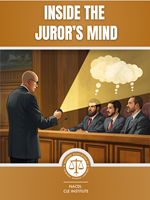
Inside the Juror's Mind: The Psychology of Juries & Decision Making
Online Version Order Here: Inside the Juror's Mind: The Psychology of Juries | NACDL CLE Catalog
CLE Credit: Up to 9 hours of self-study CLE credit, where authorized. Please confirm with your state's CLE commission to ensure this program is available for self-study CLE certification.
This powerful program examines how jurors form judgments, process evidence, and reach verdicts—and how defense lawyers can strategically influence those processes at every stage of trial. Drawing from neuroscience, social psychology, and decades of courtroom experience, it provides a systematic approach to understanding and managing juror perception, bias, and group behavior, and shows how defense attorneys can use psychology to shape voir dire, argument, and case strategy.
You'll explore the psychology behind juror and judicial decision-making, learning how the brain’s intuitive and deliberative systems influence perception and judgment. Discover why instinctive “gut” reactions—such as trust in authority or assumptions of guilt—often outweigh reason, and how to craft arguments that connect with emotion before logic. The program also addresses common psychological barriers to fairness, such as anchoring and cognitive dissonance, and demonstrates how judges are similarly affected by framing and bias. You'll gain practical strategies for structuring both written and oral advocacy to engage decision-makers more effectively.
The program also focuses on advanced voir dire and cause-based jury selection, providing a structured framework for identifying and removing biased jurors. It details how to apply the Colorado Method to develop precise questions that expose bias and validate juror impairments without alienating potential jurors. This includes normalizing bias disclosure, drafting effective questionnaires, using issue conditioning to prepare jurors for sensitive evidence, and maintaining a complete record for appellate protection, resulting in a fairer and more defensible jury selection process grounded in law and psychology.
Finally, the program examines how jurors deliberate and decide as a group, teaching attorneys how to anticipate and influence group dynamics, manage dominant personalities, and prevent conformity-driven decision-making. You'll learn to challenge unrepresentative or impaired jury pools and to present mitigation evidence effectively in serious or capital cases. Through practical instruction on humanizing clients, developing credible mitigation themes, and addressing moral reasoning around remorse and redemption, lawyers leave with concrete strategies for improving jury selection, trial advocacy, and sentencing outcomes.
Lawyers will gain actionable methods to:
- Apply decision-making science to every stage of trial, understanding how jurors rely on instinct and emotion more than logic, and how to redirect those reactions toward reasonable doubt.
- Conduct cause-based jury selection using the Colorado Method, exposing bias through targeted questioning, validating juror impairments, and building a defensible record for appeal.
- Strengthen voir dire and case themes through issue conditioning, juror questionnaires, and narrative framing that make difficult facts more approachable and less prejudicial.
- Anticipate group dynamics in deliberations—identifying dominant personalities, encouraging independent thinkers, and preventing conformity and groupthink.
- Challenge systemic unfairness by detecting juror impairment, uncovering flaws in jury administration, and protecting the right to a competent, impartial panel.
- Present persuasive mitigation by humanizing clients, integrating credible experts and lay witnesses, and reinforcing themes of remorse, hope, and redemption.
- Define and defend reasonable doubt through analogies and storytelling techniques that make the concept real to jurors.
By combining behavioral science with proven trial methods, this program gives defense lawyers a step-by-step framework for selecting fair juries, shaping deliberations, and connecting with jurors on both rational and emotional levels—improving credibility, fairness, and client outcomes in every case.
Watch a FREE Sample Here: https://bit.ly/3oaGYM0
Presentations Included:
1. The Psychology of Persuasion and Juries - Part 1 | Dyke Huish
2. The Psychology of Persuasion and Juries - Part 2 | Dyke Huish
3. Defining Reasonable Doubt to Juries | Eric Davis
4. Empowering Juror Rights, Change Deliberations and Facilitating Mistrials | SunWolf
5. Understanding the Capital Juror from the Inside Out | Scott Sundby
6. The Psychology of Jury Selection in Sexual Assault Cases | Christopher Decker
7. Jury Selection in Sexual Assault Cases | Eric Davis
8. The Colardo Method of Voir Dire | Tamara Brady and David Wymore
9. Persuading the Fact Finder | Jennifer Sellitti
Prices
- List Price $249.00
- Member Price $219.00